

Why do air-handler coils grow mold?
A cooling coil condenses moisture for most of the year. The coil face and drain pan stay wet and dark, and they collect whatever the filters let through. Microbes settle there and build a protective layer called biofilm, which shields them from cleaning. Read more on biofilm: what it is, where it grows and what it costs.
What the plant notices:
- musty or sour odors when the unit starts;
- indoor air quality complaints from the spaces it serves;
- lower airflow and cooling capacity as the coil fouls;
- fans working harder against a dirty coil;
- slime or standing water in the drain pan.
What does OSHA require for mold?
OSHA has no indoor air quality standard and no exposure limit for mold. Its indoor air quality guidance names mold and damp environments among the causes of poor indoor air, and its ventilation and air contaminant standards still apply.
Mold cases are handled under the General Duty Clause, which requires a workplace free of recognized serious hazards. In practice, that means an EHS team should be able to show it investigates complaints, controls moisture, maintains the HVAC system, and keeps records.
How to investigate an indoor air complaint tied to an air handler
- Log the complaint: the area, the time, what people noticed, and which unit serves the space.
- Inspect the coil face and drain pan with the unit locked out. Photograph growth and standing water.
- Measure coil pressure drop and check that the condensate drain runs.
- Find the moisture source: drain slope, trap, coil carryover, wet insulation, or a leak.
- Clean the coil and pan, then fix the moisture source. Cleaning without the fix brings the growth back. Many coil cleaners are corrosive, so check the safety data sheet before the crew starts.
- Add a continuous control and a measurement, so a return of the problem shows up in the data before it shows up as a complaint.
Where on-coil UV-C fits
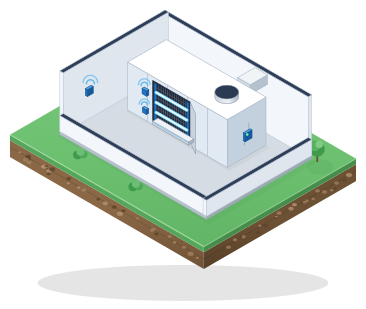
Cognituv Grid mounts across the coil face, with the lamps running horizontally, and treats the coil and drain pan continuously. It keeps a new biofilm from establishing after the coil is cleaned.
In hierarchy-of-controls terms, that moves coil hygiene off a cleaning schedule, which is an administrative control, and onto an engineering control that acts at the source. It also helps the air handler, itself an engineering control, hold its design performance. In a field study for ASHRAE, Penn State researchers measured lower airside pressure drop and better heat transfer on a fouled cooling coil after UV-C was added (Firrantello et al., 2016). See where Cognituv sits in the hierarchy of controls.
- Clean first. A heavily fouled coil needs cleaning before UV-C goes in; UV-C then keeps it from fouling again.
- Fix moisture mechanically. A blocked drain or a wet duct is a mechanical repair, recorded as its own action.
- Service with the lamps off. UV-C in an air handler is switched off and locked out before anyone opens the unit, the same as the fan.
At Phoenix Sky Harbor, mold was reduced in the treated air handlers, confirmed by the cleaning contractor’s swabs. Read the Phoenix Sky Harbor case study.
Odor and VOCs in occupied support areas
Some complaints start in the room itself: break rooms, locker rooms, lab support areas and offices next to production. Enclosed in-room units such as FreshFilter combine UV-C with photocatalytic and carbon stages for odor in occupied spaces.
Local exhaust ventilation stays the control for process emissions at the source. A room TVOC sensor shows trends, but it isn’t compound-specific. Exposure to a named chemical is still assessed by industrial hygiene sampling against its OSHA limit.
What to measure
| Measurement | What it shows | Cognituv Connect sensor |
|---|---|---|
| Coil pressure drop | Fouling building up on the coil | Differential pressure sensor |
| UV-C lamp output | The control is running at the coil | UV-C irradiance sensor |
| Temperature and humidity | Moisture at the coil and in the space | Temperature and humidity sensor |
| Fan current | How hard the fan works against the coil | Smart current sensor |
| CO₂, TVOC and particulates | Conditions in the occupied space | Indoor air quality monitor |
Together with before-and-after swabs, these readings give the EHS file a measured record, compared against a baseline agreed for the site.
Frequently asked questions
Is there an OSHA exposure limit for mold?
No. OSHA has no mold standard and no exposure limit for mold. It addresses mold through the General Duty Clause and its indoor air quality guidance.
Does UV-C remove mold that is already on a coil?
Clean the coil first. UV-C works best running continuously on a clean surface, where it keeps new growth from establishing.
Does on-coil UV-C change filter maintenance?
No. It treats the coil and the drain pan. Filters stay on their normal schedule.
How do we know the UV-C is working?
Track coil pressure drop against the baseline, confirm lamp output with a UV-C sensor, and take swabs before installation and at the 90-day review.
Who should own an air-handler mold problem?
Maintenance owns the unit and the repair. EHS owns the complaint, the investigation record and the decision that the hazard is controlled. Both need the same data.
Performance depends on installation, airflow, moisture control and maintenance; results are verified by measurement, not assumed. Updated November 6, 2026.