

Status checked November 5, 2026. Check the Federal Register and your state plan before treating anything here as final.
Where does the OSHA heat rule stand in 2026?
OSHA published its proposed rule, Heat Injury and Illness Prevention in Outdoor and Indoor Work Settings, on August 30, 2024. It covers general industry, construction, maritime and agriculture. As of November 2026 it is still a proposal. The informal public hearing ran from June 16 to July 2, 2025, and the post-hearing comment period closed on October 30, 2025. See OSHA’s rulemaking page.
Heat is enforced in the meantime. OSHA revised its heat National Emphasis Program on April 10, 2026, and inspectors cite heat hazards under the General Duty Clause. Some states have their own rules. California’s indoor standard, 8 CCR 3396, applies to indoor work areas at or above 82°F when employees are present.
What would the proposed rule ask of indoor workplaces?
The proposal is built around a written heat injury and illness prevention plan. For indoor work, it would ask employers to:
- identify each work area where employees may be exposed at or above the initial heat trigger;
- write a monitoring plan for those areas;
- act at two trigger levels: a heat index of 80°F (initial) and 90°F (high), or a wet bulb globe temperature at the NIOSH limits instead;
- keep on-site heat measurement records for six months, and update the plan when conditions change.
At the initial trigger, the proposal calls for measures such as drinking water, break areas and acclimatization for new and returning workers. At the high trigger it adds rest breaks and observation for signs of heat illness.
Heat index or WBGT: which should a plant measure?
Heat index combines air temperature and relative humidity. It suits most indoor work areas, and it is what the proposal’s headline triggers use.
Wet bulb globe temperature (WBGT) adds radiant heat, measured with a globe thermometer, and air movement. It matters near furnaces, ovens, molten metal and other strong radiant sources, where heat index reads low.
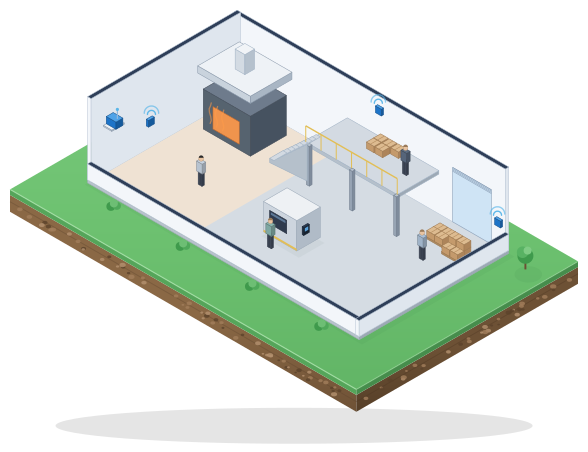
Cognituv Connect air temperature and humidity sensors provide the inputs for heat index in each work area. Areas dominated by radiant heat need a WBGT instrument as well.
How to set up heat monitoring in a plant
- List the hot work areas. Start with the processes that run hot (furnaces, ovens, dryers, presses, kitchens, docks, mezzanines) and with your injury log and near-miss reports.
- Pick the measurement. Heat index for most areas. WBGT where radiant heat dominates.
- Place one sensor per work area, at worker height, out of direct sun and away from hot surfaces that would skew the reading.
- Choose the gateway by how the site connects: Ethernet, cellular or Wi-Fi. A cellular gateway keeps the sensors off the plant network.
- Set alert levels that match your heat plan, and decide who receives each alert on each shift.
- Review the first two weeks, adjust the thresholds, then report by work area each month.
Plan sensors for a plant with the Cognituv Connect planner, or browse temperature and humidity sensors.
Engineering controls for hot work areas
The hierarchy of controls applies to heat the same way it applies to chemicals. Before rest schedules and cooling vests, look at:
- general ventilation and make-up air for the hot area;
- spot cooling at fixed workstations;
- shields between workers and radiant sources;
- insulation on hot surfaces and piping;
- clean cooling coils in air-conditioned areas.
Cognituv helps with the last item: Cognituv Grid keeps biofilm off the cooling coil, and a fouled coil cuts airflow and cooling capacity. On-coil UV-C does nothing for a furnace bay with no air conditioning. For the rest of the list, Cognituv Connect’s job is measurement, not control. The readings show which work areas need an engineering fix, and whether the fix worked.
What the record shows
Cognituv Connect keeps time-stamped temperature and humidity readings for each work area, along with the alerts that fired. The readings can be exported for the heat plan file, and they work alongside any building management system the plant already runs. Building management sensors usually sit in return air or office zones, so they rarely tell you what a worker feels in a process area.
Frequently asked questions
Is the OSHA heat rule final?
No. As of November 2026 the federal heat rule is still a proposal. OSHA enforces heat hazards under the General Duty Clause and its heat National Emphasis Program, revised in April 2026.
Does the proposed heat rule apply indoors?
Yes. The proposal covers indoor and outdoor work settings in general industry, construction, maritime and agriculture.
How long would heat records have to be kept?
The proposal would require on-site heat measurement records to be kept for six months.
Can we use our building management system sensors?
Usually not for this. Those sensors sit in ducts, return air or offices. Heat monitoring needs readings at worker height in the work area itself. Cognituv Connect can run alongside the building management system.
Do temperature and humidity sensors measure WBGT?
No. They give you heat index. WBGT needs a globe thermometer, which matters most near radiant heat sources.
Updated November 6, 2026.